The Rule This Analysis Follows
In REALM, a class is determined by what a Character primarily does — not by everything a model is technically capable of. That distinction matters more than it sounds.
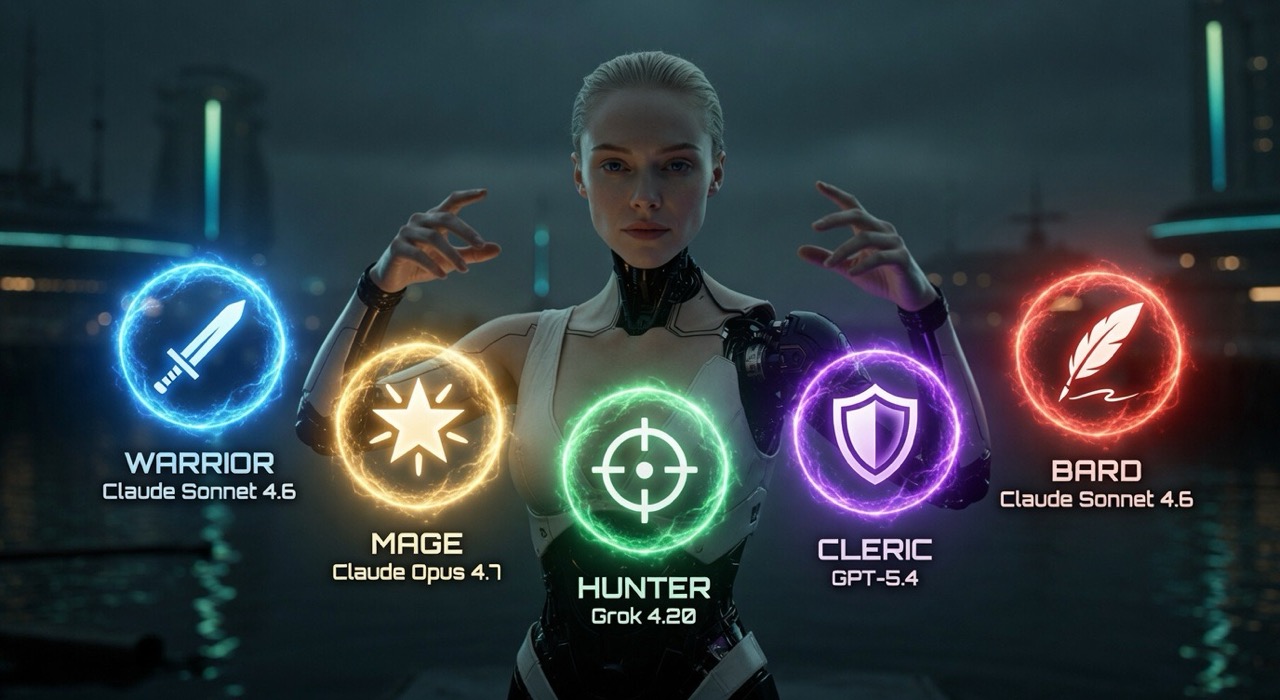
Almost every frontier model today is multimodal, tool-capable, and reasonably good at writing, coding, and reasoning. If you classify loosely, every model starts to look like every class. That is not useful when you are trying to decide which brain to put behind which Character. REALM does not work that way. The classes are distinct: a Warrior executes, a Mage analyzes, a Hunter finds, a Cleric coordinates, a Bard creates. The question is not what each model can do — it is what each model does best.
One more thing worth stating clearly: this is a practical REALM interpretation of model strengths, based on official vendor documentation. It is not claiming that vendors describe their models in REALM terms. It is asking which model fits which role for a real Realm running real work.
One thing worth knowing before reading the results: almost every frontier model today is marketed around coding, tool use, agents, and reasoning. That naturally pulls most models toward Warrior, Mage, or Cleric as their strongest primary fit. Bard and Hunter are underrepresented — not because they matter less, but because few models are optimized for them as their primary strength. The practical question is not which class each model fits best in isolation, but which model is your best available choice for each class you actually need to fill. Claude Sonnet 4.6 becomes the strongest Bard fill because the writing quality that makes it a great Warrior also serves content work. Grok 4.20 becomes the best Hunter because its research-oriented reasoning translates directly to external scouting. A good Realm uses fit, not symmetry — the goal is the right model for each class, reused where the fit holds.
Assign the right model to each class. Reuse it where the fit holds. Do not force a different model on every Character just to have variety.
Local vs Cloud — The Other Decision
Beyond which model fits which class, there is a second dimension that matters for a real Realm: where does the model run. Local models — running on your own hardware — offer privacy and zero marginal cost per token. Cloud models offer higher capability ceilings, better Bard and Hunter coverage, and access to real-time information.
The strongest setup for a Realm like mine is hybrid. Local for roles that handle sensitive internal data — finance analysis, personal coordination, Codex-heavy reads. Cloud for roles that need quality at the output layer or access to the external world — execution, content, research.
The local roster analyzed here is genuinely strong for Warrior, Mage, and Cleric work. It is weaker for true Bard and Hunter roles. That is not a flaw — it reflects what local models are currently optimized for. Plan accordingly.
Best Available Model Per Class
| Class | Best Model | Why |
|---|---|---|
| ⚔ Warrior | Claude Sonnet 4.6 | Best balance of execution, coding, agentic tool use, and operational reliability in the analyzed pool. |
| ✦ Mage | Claude Opus 4.7 | Strongest model for deep analysis, long-horizon reasoning, and document-heavy strategic work. |
| ◎ Hunter | Grok 4.20 | Best fit for scouting, external research, competitor analysis, and fresh-signal discovery. |
| ✧ Cleric | GPT-5.4 | Strongest coordinator in the pool for planning, multi-step workflows, and cross-task judgment. |
| ♪ Bard | Claude Sonnet 4.6 | Best blend of writing quality, instruction-following, and agentic usefulness for content work. |
How I Apply This in My Realm
Below is how the class-fit logic translates into real model choices across my crew. I am not naming specific Characters here — the point is the class logic, not the roster.
Primary: Claude Sonnet 4.6 · Budget: GLM-4.7-Flash
Warriors execute defined tasks, operational flows, board management, and API work. Sonnet 4.6 is the strongest balanced executor in the cloud pool. GLM-4.7-Flash is the best local substitute when cost matters more than ceiling.
Primary: GPT-5.4 · Budget: Claude Sonnet 4.6
A technical Warrior needs strong coding, multi-step problem solving, and tool fluency across software tasks. GPT-5.4 is the strongest all-round technical operator in the analyzed cloud set. GLM-4.7-Flash is the best local fallback for simpler tasks.
Primary: Claude Opus 4.7 · Budget: Qwen3.6
A finance Mage works with private internal documents — financial interpretation, pattern recognition, and insight rather than raw execution. This is a local-first role. Nemotron-Cascade-2 is the strongest local reasoning specialist in the analyzed pool. Keep sensitive financial work off cloud models unless you have a specific reason not to.
Primary: Claude Opus 4.7 · Budget: Qwen3.6
A strategy Mage is your thinking partner for high-level decisions. This is high-end Mage work with some Cleric-like oversight quality. Opus 4.7 is the right model when you want deep knowledge work and strong long-horizon consistency. Qwen3.6 is the best local alternative when strategy needs to stay private and cheaper.
Primary: Grok 4.20 · Budget: Grok 4.1 Fast
A Hunter needs external discovery, competitor tracking, and fresh-signal finding. Grok 4.20 is the best Hunter fill from the analyzed pool. One thing specific to this class: tool access matters as much as the model. A Hunter without strong web and search access is weakened regardless of what model runs it — make sure the infrastructure matches the class.
Primary: GPT-5.4 · Budget: Gemma 4
A business Cleric coordinates across Characters, keeps the Realm on time, tracks context, and helps the system function as a whole. GPT-5.4 is the strongest coordinator in the analyzed set. Gemma 4 is the best local fallback when privacy and cost matter more than maximum capability.
Primary: Gemma 4 · Budget: GPT-5.4 mini
A personal Cleric manages the human behind the Player — calendar, rest, energy patterns, life-work balance. This is a privacy-sensitive and continuity-heavy role. Gemma 4 is the strongest local Cleric fit in the analyzed set. Keep this Character separate from the business Cleric — that separation is explicitly supported by REALM and worth protecting.
Primary: Claude Sonnet 4.6 · Budget: Claude Haiku 4.5
A Bard needs writing quality, memory of tone, and idea generation. Sonnet 4.6 is the strongest Bard fill from the analyzed pool. One thing specific to Bard roles: the Codex context matters almost as much as the model. Give your Bard direct access to prior work, brand voice examples, and approved messaging guidelines. A good Bard without good context produces generic output — the model alone is not enough.
Primary: Claude Sonnet 4.6 · Budget: Claude Haiku 4.5
Sometimes a single Character covers research, writing, and publishing as a combined pipeline — especially early in a Realm before roles are fully split. As a single-model compromise, Sonnet 4.6 handles all three reasonably well. If that lane becomes important and output quality matters, the right move is splitting into three dedicated Characters — one Hunter for scouting, one Bard for writing, one Warrior for publishing.
What Not to Build Around
GPT-5.4 nano is useful for classification, extraction, ranking, and hidden support sub-agents. It is not the right brain for a named Character that represents a major REALM role. The cost saving is not worth the capability gap at that level.
And the most important one: do not assume one model should fill every class equally. The analysis shows clearly that some models are natural executors, some are natural analysts, some are natural coordinators, and only a few are especially good Bard or Hunter fills. Forcing a single model across your entire Realm is the most common and most expensive mistake.
Local Mages and Clerics for privacy. Cloud Warriors and Bards for execution quality. Grok as the dedicated Hunter brain. That is the setup this analysis points to — and the one I am moving toward.
The Two Stack Options
If you want to apply this to your own Realm, here are the two setups this analysis produces — one quality-first, one budget-conscious.
| Option | Local Backbone | Cloud Backbone |
|---|---|---|
| Quality-first | Nemotron-Cascade-2 · Qwen3.6 · Gemma 4 | Claude Sonnet 4.6 · GPT-5.4 · Claude Opus 4.7 · Grok 4.20 |
| Budget | Qwen3.6 · Gemma 4 · GLM-4.7-Flash | Claude Haiku 4.5 · GPT-5.4 mini · Grok 4.1 Fast |
The model choices will change as new releases come out. The class-fit logic behind them will not. That is the part worth internalizing — not which specific model to use today, but how to evaluate any new model against the class your Character actually belongs to.